

 CN
 EN

What do you need to consider when choosing a real-time DSP for car specifications? ——Guidelines for Domestic Alternative Selection of AVP32F00157
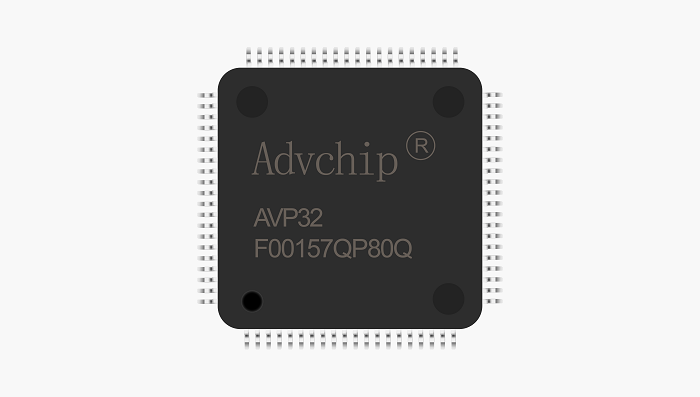
Is Raw Clock Frequency Enough? Look Beyond the Clock Speed
Engineers working on motor control and digital power converters know that real-time performance is not determined by clock frequency alone. It hinges on whether the computing capability matches the control algorithms. FOC coordinate transformation, SVPWM implementation and loop compensation for digital power are all floating-point intensive operations.
The AVP32F00157 is built on a 32-bit floating-point DSP architecture running at 120 MHz. It integrates an IEEE 754-compliant FPU and a TMU trigonometric math accelerator. The device features 256 KB ECC-protected Flash and 36 KB SRAM with ECC/parity protection, offering sufficient memory footprint for control algorithms and protection routines. Its dual-lockstep core, paired with a lockstep comparator and power-on self-test circuitry, embeds functional safety mechanisms to meet automotive-grade reliability requirements.
Are On-Chip Peripherals Sufficient? Missing One Means Extra External Components
Even with ample computing power, the controller needs adequate peripherals for actuation. PWM generation, ADC sampling, comparator protection and communication interfaces — any missing function forces additional external components.
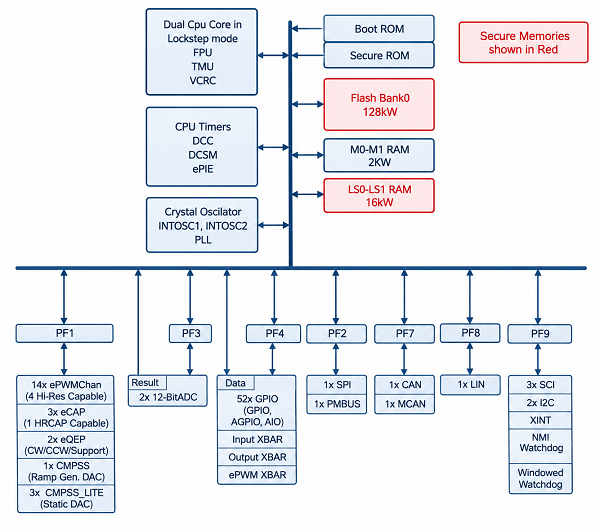
The AVP32F00157 integrates a rich control-centric peripheral set:
14 channels of ePWM with hardware dead-band and trip protection
High-resolution PWM (HRPWM) with resolution down to 150 ps
Dual 12-bit ADCs at up to 4 MSPS, supporting a maximum of 21 external channels
CMPSS comparators for fast fault protection
Real-time control peripherals including eQEP and eCAP
Communication interfaces: CAN/CAN-FD, LIN, SPI, I²C, SCI and PMBus
Critical functions from signal sampling, algorithm execution, PWM generation to fault protection can be closed entirely on-chip.
How Much Redesign Is Required for Drop-In Replacement?
This is often the most practical concern in domestic semiconductor substitution. Redesigning PCB layouts, porting firmware and revalidating control algorithms can turn a proven platform into a brand-new project.
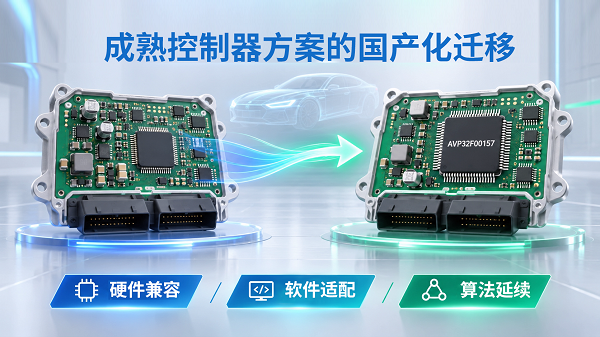
Targeting mainstream 32-bit real-time control DSP applications, the AVP32F00157 is designed for compatibility benchmarking. It is available in LQFP48/64/80 and QFN32 packages with pin-to-pin compatible options. Mature controller platforms can migrate to this domestic solution while largely retaining existing hardware and software architecture, drastically reducing redesign overhead. Pre-validated control algorithms such as FOC and digital power loops can be adapted and verified based on the original control framework.
In short, the goal of domestic substitution is not to start development from scratch, but to keep proven solutions operational with minimal changes.
Target Applications: From OBC to Motor Drives
On-Board Charger (OBC)High-frequency PFC and CLLLC topologies demand high PWM resolution. The 150 ps HRPWM, dual ADCs and PMBus/CAN-FD of the AVP32F00157 fit these requirements natively.
DC-DC ConvertersDC-DC regulation requires simultaneous voltage/current sampling and fast closed-loop control. HRPWM paired with high-speed ADCs supports high-performance dual-loop regulation.
Motor InvertersThe FPU and TMU accelerate floating-point computation; ePWM generates drive signals; eQEP captures position feedback; CMPSS enables rapid fault protection. The full signal chain from sampling to PWM output is closed on-chip.
Air-Conditioning CompressorsThe floating-point core executes sensorless FOC and observer algorithms, while LIN/CAN-FD receives thermal management commands from the vehicle domain.
Beyond these, the device can be evaluated for EPS, electric oil/water pumps, electronic turbochargers, cabin heaters, BMS slave nodes and auxiliary VCU control according to specific control specifications.
Closing Remarks
The real challenge of automotive-grade DSP domestic substitution lies far beyond the peripheral count listed on a datasheet. It comes down to platform migration feasibility, algorithm reusability and consistent technical support after mass production.

For proven designs based on mainstream 32-bit real-time control DSPs, the AVP32F00157 delivers a domestic alternative with matched computing performance, dedicated real-time peripherals and pin-to-pin compatibility.
If you are evaluating real-time control applications including OBC, DC-DC, motor inverters, air-conditioning compressors, EPS and pumps, ADVANCECHIP provides sample requests, evaluation board resources, selection guides and reference design support. Feel free to contact us.