

 CN
CN
 EN
EN

From electric drive to charging: Integrated AVP32F00157 connects the entire power chain of new energy vehicles

The "power heart" of new energy vehicles is not an isolated component, but an organic whole composed of subsystems such as motor control, DC/DC conversion, on-board charging (OBC), and vehicle energy dispatch; Electric energy is converted and flows between each link, and control signals interact in real time to form a complete power domain control chain. Insufficient control accuracy in any link will directly affect the energy efficiency performance and driving smoothness of the entire vehicle.
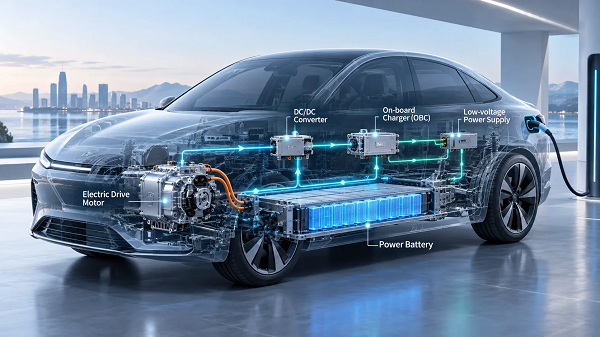
And the requirements for control chips in these scenarios are often consistent: fast response speed, high control accuracy, and reliable operation guarantee.
The automotive grade DSP AVP32F00157 from Jinxin Technology is designed specifically for high-precision and high reliability power control scenarios.
Covering multiple control scenarios in the power domain
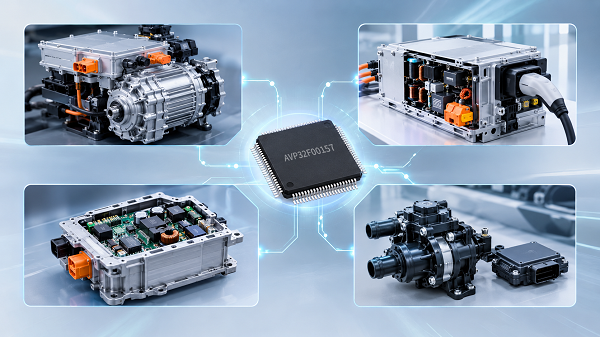
the field of power and energy management, the AVP32F00157 can be applied to:
DC/DC converters — core components of the vehicle low-voltage power supply system
Inverters and motor control — critical control units that drive motor operation
On-board chargers (OBC) and wireless charging — the gateway that converts external electricity into on-board power
Vehicle control units (VCU) — the "brain" that coordinates all components of the powertrain
Engine fans, electronic turbochargers — auxiliary units for powertrain heat dissipation and air intake
Pump control — auxiliary systems for coolant circulation, oil pumps and more
Automatic transmissions — shift control for power output
Electric power steering (EPS) — electronic assist control for steering systems
From "how electric power is converted", to "how motors rotate", and further to "how the vehicle operates" — a single chip connects multiple key nodes of the powertrain. This is where the value of automotive-grade DSPs differentiates them from general-purpose MCUs: they are not merely viable for individual functions, but capable of covering diverse segments across the entire powertrain chain, delivering a unified technology foundation for engineering teams.
Core Capability Analysis
Dual-Core Lockstep Architecture: Balancing Precision and Reliability
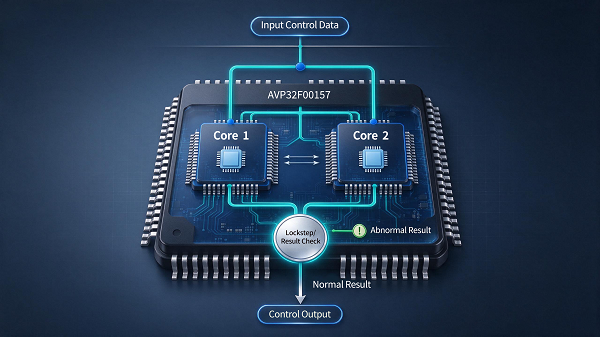
The AVP32F00157 adopts a dual-core lockstep design, where two processing cores run synchronously and cross-verify calculation results. This architecture is widely deployed in control systems with stringent functional safety requirements. Should computation anomalies occur on one core, the other core can detect discrepancies instantly, delivering superior operational reliability compared with single-core solutions.
This capability is particularly critical for safety-related applications such as motor control and VCU, which directly affect vehicle driving safety.
120 MHz Real-Time Core with Hardware Acceleration for Floating-Point and Trigonometric Functions
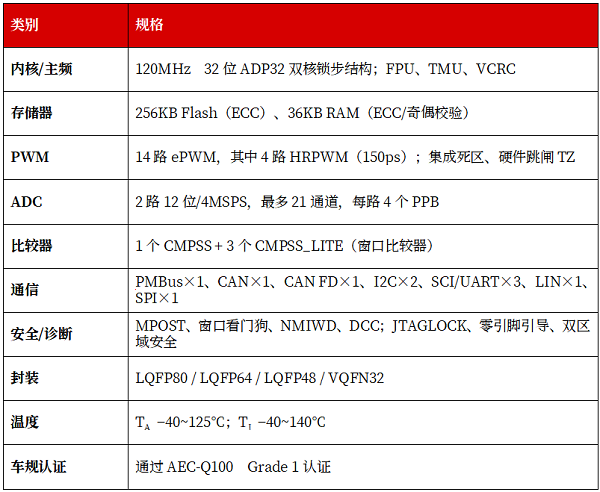
Built around a 32-bit DSP core running at 120 MHz, the AVP32F00157 integrates an IEEE‑754 single-precision FPU, TMU and VCRC. The TMU provides hardware acceleration for sine/cosine calculations, substantially boosting the execution efficiency of real-time algorithms including FOC and reducing control loop latency.
High-Resolution PWM for Fine-Grained Control
The chip features 14 ePWM channels, among which 4 HRPWM channels deliver a resolution of 150 ps. It also integrates dead-time generation and hardware trip zones (TZ). Fine and continuous duty-cycle regulation enables smoother motor speed and more linear torque output, improving vehicle acceleration smoothness and low-speed NVH performance.
Dual High-Speed ADCs for Fast Sensing and Rapid Response
The device integrates two 12-bit / 4 MSPS ADCs (up to 21 channels total, with 4 PPBs per ADC), paired with one CMPSS and three CMPSS_LITE modules. The comparators support peak current mode control, PFC and voltage trip functions. In overcurrent or overvoltage events, the hardware can bypass firmware and shut down PWM directly via TZ, enabling fast hardware-level protection for high-voltage power conversion applications such as OBC and DC/DC.
Comprehensive Communication Interfaces, Native Compatibility with In-Vehicle Networks
The chip is equipped with CAN, CAN FD, LIN, SPI, I²C, PMBus and 3 SCI channels (UART-compatible). It can connect directly to the vehicle network and communicate with peripheral actuators without extra interface conversion, helping simplify hardware design and shorten development cycles.
Automotive-Grade Reliability Design
The AVP32F00157 also implements targeted designs for memory and system security. It supports zero-pin boot, dual-zone security and wide-temperature-range operation, meeting requirements for long-term stable operation in automotive environments.
AVP32F00157 Parameter Overview
Supporting Development Resources
Featuring high integration and automotive-grade reliability, the AVP32F00157 simplifies system hardware while maintaining control performance, serving as a candidate for the core controller in powertrain domains. ADVCHIP will continue to deepen its independent R&D of automotive-grade DSPs, delivering more domestic alternatives for new energy vehicle powertrain control.
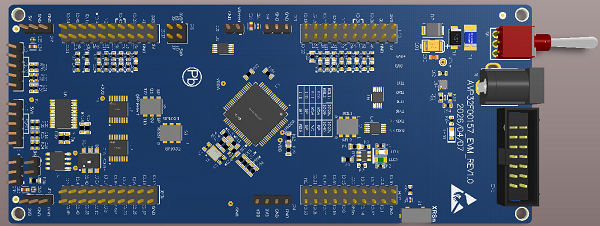
To enable engineering teams to rapidly validate solutions, ADVCHIP provides AVP32F00157 samples and corresponding evaluation boards, supporting the full workflow from selection assessment to solution development.